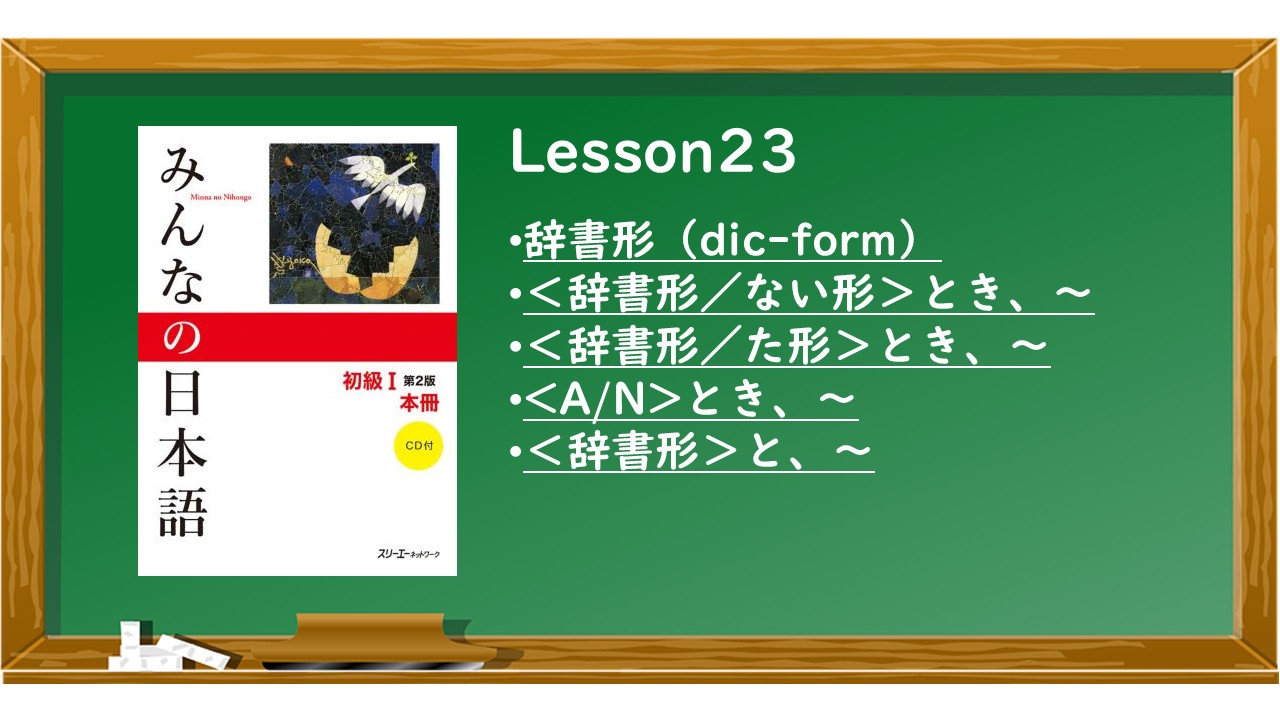
A1[Dic-form/ない-form]とき、~
Meaning:
- The word とき in Japanese means“when”or“at the time.”It is used to indicate the time when an action occurs.
How to use:
[Dic-form/ない-form] とき
Example:
- 寝るとき、電気を消します。- I turn off the lights when I go to sleep.
- 本を読むとき、めがねをかけます。- I put on my glasses when I read books.
- 漢字の読み方がわからないとき、先生に聞きます。- When I don’t know how to read a Kanji, I ask the teacher.
- 時間がないとき、朝ご飯を食べません。- When I don’t have time, I don’t eat breakfast.
A2[Dic-form/た-form]とき、~
Meaning:
- Use the dictionary form before とき for an action that is not yet finished, and the た-form before とき for an action that is already finished.
How to use:
[Dic-form/た-form] とき
Example:
- 日本へ行くとき、かばんを買いました。- I bought a bag before going to Japan.
- 日本へ行ったとき、かばんを買いました。- I bought a bag when I went to Japan.
- ご飯を食べるとき、「いただきます」と言います。- I say “Itadakimasu” when I eat.
- うちへ帰ったとき、「ただいま」と言います。- I say “Tadaima” when I go home.
A3[Adjective/Noun]とき、~
Meaning:
- Adjectives and nouns can also be used in this grammar.
How to use:
[い-adjective] とき
[な-adjective な] とき
[Noun の] とき
Example:
- 眠いとき、顔を洗います。- When I am sleepy, I wash my face.
- 暇なとき、友達に連絡します。- When I am free, I contact my friends.
- 大学生のとき、アルバイトをしました。- When I was a university student, I had a part-time job.
- 25歳のとき、アメリカへ行きました。- When I was 25 years old, I went to America.
A4 ~と、~
Meaning:
- Use と to connect two sentences when one action naturally causes another action or result.
- ~と is used when the same result always happens, so it is often used for machine systems or natural phenomena.
- ~と is also often used when giving directions.
How to use:
[Dic-form] と
Example:
- ボタンを押すと、コーヒーが出ます。- When you press the button, coffee comes out.
- これを回すと、音が大きくなります。- When you turn this, the volume gets louder.
- 北海道は冬になると、雪が降ります。- When it becomes winter in Hokkaido, it snows.
- お酒を飲むと、顔が赤くなります。- When I drink alcohol, my face gets red.
- 次の信号を右へ曲がると、スーパーがあります。- When you turn right at the next traffic light, there is a supermarket.
- 橋を渡ると、Leeさんのうちがあります。- When you cross the bridge, you will find Mr. Lee’s house.
Fun Japanese Lessons: Talk and Learn with Me!
Do you want to practice Japanese? Join my lessons!
If you’re interested, please contact me using the inquiry form below.