A1 [Verb]+[Noun]
Meaning:
- In Lessons 2 and 8, you learned how to modify nouns.When modifying a noun, you can also use a verb, and the verb is used in its plain form.
How to use:
[Verb plain form] +[Noun]
Example:
- 子どもが読む本– books that children read
- 子どもが読まない本– books that children do not read
- 昨日、読んだ本– the book I read yesterday
- 昨日、読まなかった本– the book I did not read yesterday
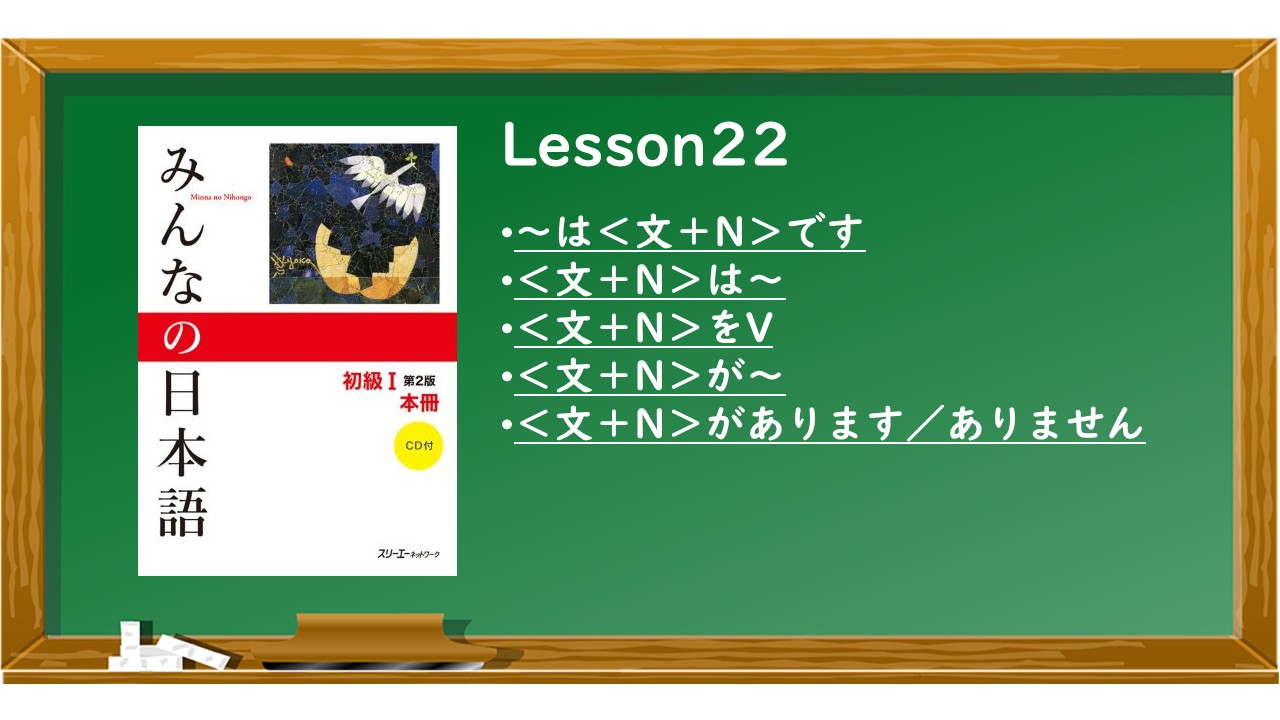
A2 [Noun1]は [Verb]+[Noun2]です
Meaning:
- In this sentence pattern, a verb phrase modifies the subject (Noun1).
Example:
- これは子どもが読む本です。- This is a book that children read.
- これは母にもらったかばんです。- This is the bag my mother gave me.
- ここは山田さんが働いている会社です。- This is the company where Mr. Yamada works.
- 伊藤さんはどの人ですか。…メガネをかけている人です。- Which one is Mr. Ito? …He is the person wearing glasses.
A3[Verb]+[Noun]は~です/ます
Meaning:
- In this sentence pattern, the“verb + noun”phrase acts as the subject. The information that follows“は”is the new information. This pattern is often used in questions.
Example:
- 子どもがよく見るアニメはNARUTOです。- The anime that children often watch is NARUTO.
- わたしが乗っている車は古いです。- The car I am driving is old.
- わたしが働いている会社は東京にあります。- The company where I work is in Tokyo.
- 青いシャツを着ている人はだれですか。…佐藤さんです。- Who is the person wearing the blue shirt? …It is Mr. Sato.
A4 ~は[Verb]+[Noun]を~ます
Meaning:
- In this sentence pattern, the“verb + noun”construction acts as the object.
Example:
- 明日の朝に食べるおにぎりを買いました。- I bought some onigiri to eat tomorrow morning.
- 昨日かいた絵を父に見せます。- I’m going to show my father the picture I drew yesterday.
- 山田さんが働いている会社を知っていますか。- Do you know the company where Mr. Yamada works?
- 何を食べましたか。…昨日買ったパンを食べました。- What did you eat? …I ate the bread I bought yesterday.
A5 ~は[Verb]+[Noun]が~です/~ます
Meaning:
- This sentence pattern is used with predicates that take the particle が, such as“すき”,“わかります”, or“ほしい”.
Example:
- わたしはよく勉強する人が好きです。- I like people who study hard.
- 旅行ではく靴が要ります。- I need shoes to wear for the trip.
- 日本人の
友達が話す日本語がわかりません。- I don’t understand the Japanese that my Japanese friends speak. - どんなロボットが欲しいですか。…
部屋を掃除するロボットが欲しいです。- What kind of robot do you want? …I want a robot that cleans the room.
A6 ~は[Verb]+[Noun]があります/ありません
Meaning:
- This sentence pattern uses“あります”or“ありません”as the predicate. In this section, it is used with nouns such as“じかん”or“やくそく”.
Example:
- 彼女に会う時間がありません。- I don’t have time to see my girlfriend.
- 友達と映画を見る約束があります。- I have plans to see a movie with my friend.
- 一緒に食事しませんか。…すみません、郵便局へ行く用事があります。- Would you like to have a meal together? …I’m sorry, I have an errand at the post office.
Fun Japanese Lessons: Talk and Learn with Me!
Do you want to practice Japanese? Join my lessons!
If you’re interested, please contact me using the inquiry form below.