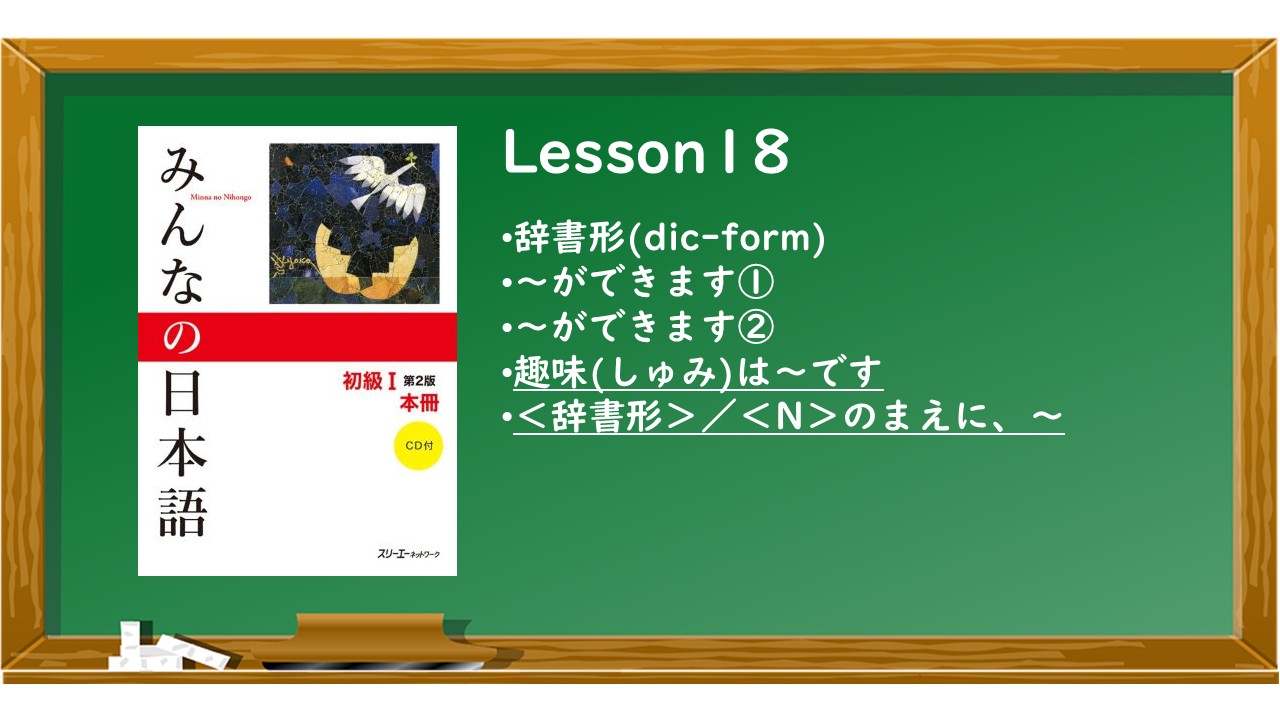
A1 じしょけい(dictionary-form)
Meaning:
- It is called the“じしょけい(dictionary form)”because you can find verbs in this form in a dictionary.
- For Group 1 verbs, the last sound of the ます-form is always from the“i”line. To make the dictionary -form, change that sound to the“u”line.
- The way to make the dictionary-form depends on the verb group, as explained below.
A2 ~ができます①
Meaning:
- できます”is a verb that shows ability. Use the particle“が”before“できます”. The noun or“Dictionary Form + こと”before“が”shows what you can do.
How to use:
[Noun] ができます
[じしょけい+こと] ができます
Example:
- わたしはダンスができます。- I can dance.
- 父は中国語ができます。- My father can speak Chinese.
- 彼は漢字を書くことができます。- He can write Kanji.
- どんな料理を作ることができますか。…日本の料理を作ることができます。- What kind of dishes can you cook? …I can cook Japanese food.
A3 ~ができます②
Meaning:
- “できます”can also show what you can do in a certain place, in a certain situation, or by using a certain tool.
How to use:
[Noun] ができます
[じしょけい+こと] ができます
Example:
- この公園でテニスができます。- You can play tennis in this park.
- この美術館でフランスの絵を見ることができます。- You can see French paintings at this museum.
- インターネットで飛行機の予約ができます。- You can make flight reservations on the internet.
A4 しゅみは~です
Meaning:
- “しゅみ”means“hobby”. You can use this pattern to talk about your hobbies.
- Using“Verb (Dictionary Form) + こと”allows you to describe your hobbies more specifically
- than using only a noun.
How to use:
しゅみは[N/じしょけい+こと]です
Example:
- わたしの趣味はカラオケです。- My hobby is karaoke.
- 父の趣味は野球の試合を見ることです。- My father’s hobby is watching baseball games.
- 趣味は何ですか。…映画を見ることです。- What is your hobby? …It is watching movies.
A5 ~まえに、~①
Meaning:
- “まえに”means“before”.
- This pattern shows that the action of V2 happens before the action of V1/N.
- When you use a noun before“まえに”, use a noun that shows an action or a noun for an event.
How to use:
[Noun+の] まえに、[V2]
[じしょけい(V1)] まえに、[V2]
Example:
- うちへ帰るまえに、スーパーで買い物します。- I will go shopping at the supermarket before going home.
- 会議の前に、資料をコピーします。- I will copy the documents before the meeting.
A5 ~まえに、~②
Meaning:
- When you put a word for a period of time before“まえに”, it means“ago”, In this case, you do not need the particle“の”.
How to use:
[Noun(perood)] まえに
Example:
- 30分まえに起きました。- I woke up 30 minutes ago.
- 半年まえに、日本語の勉強を始めました。- I started studying Japanese half a year ago.
- いつ部長は帰りましたか。…10分まえに、帰りました。- When did the manager leave? …He left 10 minutes ago.
なかなか
Meaning:
- When“なかなか”is used with a negative expression, it means“not easily”or“not as expected”.
Example:
- お金がなくて、なかなか車を買うことができません。- I don’t have enough money, so I can’t afford to buy a car easily.
- バスがなかなか来ません。- The bus is taking a long time to come.
- 日本語がなかなか上手になりません。- My Japanese isn’t improving as quickly as I’d like.
ぜひ
Meaning:
- “ぜひ”is used with expressions of hope or requests, such as“~たいです”and“~てください”. It emphasizes the meaning of these expressions.
Example:
- ぜひ、また遊びに来てください。- Please do come and visit again.
- 沖縄は海がとてもきれいですよ。…そうですか。ぜひ、行きたいです。- The sea in Okinawa is very beautiful. …Is that so? I definitely want to go.
Fun Japanese Lessons: Talk and Learn with Me!
Do you want to practice Japanese? Join my lessons!
If you’re interested, please contact me using the inquiry form below.