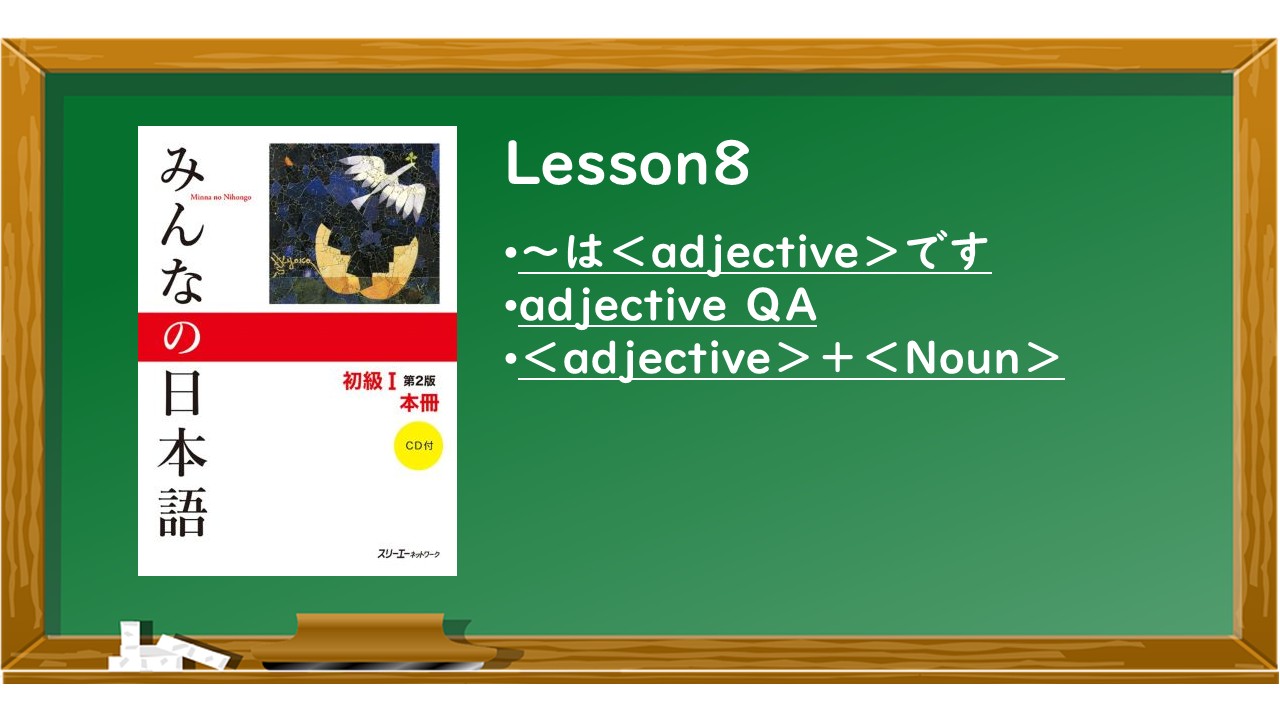
A1 ~は [adjective]です
How to use:
[Noun] は [adjective] です
Example:
- 桜はきれいです。- The cherry blossoms are beautiful.
- すしはおいしいです。- Sushi is delicious.
- 東京はどうですか。…便利です。- How is Tokyo? … It is convenient.
~です。そして~です。/~ですが、~です。
Meaning:
- “そして” functions as a sentence connector similar to “and.”
- The conjunction particle “が” is equivalent to “but” and is used to link two sentences together.
How to use:
[Sentence] そして/が [Sentence]
Example:
- SUSHIROはどうですか。…おいしいです。そして安いです。- How is SUSHIRO? … It is delicious and cheap.
- 日本の生活はどうですか。…楽しいですが、忙しいです。- How is life in Japan? … It is fun, but busy.
いけいようし(い-adj)/なけいようし(な-adj)
Meaning:
- Japanese adjectives are divided into two types: い-adjectives and な-adjectives.
- An adjective that ends in “い” is an い-adjective. An い-adjective keeps the “い” and comes before です. example)やすい、おいしい、たかい
- An adjective that ends in “な” is an な-adjective. A な-adjective comes before です without “な”. example)べんり(な)、ひま(な)、にぎやか(な)
A2 Negative form of adjectives
Meaning:
- The negative form of “な-adj です” is “な-adj じゃありません”.
- To make the negative form of an い-adjective, change the “い” at the end to “くない”.
- The negative for “いいです” is “よくないです”.
Example:
- 東京は静かですか。…いいえ、静かじゃありません。- Is Tokyo quiet? … No, it is not quiet.
- あのレストランはおいしいですか。…いいえ、おいしくないです。- Is that restaurant delicious? … No, it is not delicious.
- このパソコンはよくないです。- This computer is not good.
とても/あまり
Meaning:
- “そして” is a conjunctive word that functions like “and.” It is used to provide supplementary information to the preceding sentence.
- “とても” is used in affirmative sentences and means “very”.
- “あまり” is used in negative sentences, and with a negative form it means “not very.”
Example:
- すしはとてもおいしいです。- Sushi is very delicious.
- その車は高いですか。…いいえ、あまり高くないです。- Is that car expensive? … No, it is not very expensive.
A3 [adjective] + [noun]です
Meaning:
- An adjective comes before a noun to describe it.
- A な-adjective needs “な” when it comes before a noun.
- When asking questions, use “What kind of…”
How to use:
[Adjective] + [Noun] です
Example:
- 京都は古い町です。- Kyoto is an old town.
- ABCは新しい学校です。- ABC is a new school.
- 大阪はにぎやかな町です。- Osaka is a lively town.
- 彼はどんな人ですか。…元気な人です。 – What kind of person is he? … He is a cheerful person.
- 日本でおいしいすしを食べました。- I ate delicious sushi in Japan.
- きのうきれいな人に会いました。- I met a beautiful person yesterday.
Fun Japanese Lessons: Talk and Learn with Me!
Do you want to practice Japanese? Join my lessons!
If you’re interested, please contact me using the inquiry form below.