A1・2 ふつうけい(plain-form)
Meaning:
- Japanese language has two styles of speech: polite style(ていねいけい) and plain style(ふつうけい).


Note:
※Polite form
- When there is social distance: People you meet for the first time or people you are not close to yet (including those of the same age or younger).
- When showing respect: People of higher status, your boss, or your teachers.
※Plain form
- Close relationships: Family and close friends.
- Equal relationships: Colleagues you are close with.
Conversation in the plain form(Verb/い-adj)
Note:
- In the plain form, questions usually do not use the particle“か”. Instead, they end with a rising intonation, like“のむ? (⤴)”.
Example:
- ジュースを飲む?…うん、飲む。/ううん、飲まない。- Want some juice? … Yeah, I’ll have some. / No, I’m good.
- 昨日は何をした?…映画を見た。- What’d you do yesterday? … I watched a movie.
- それ、おいしい?…うん、おいしいよ。/ううん、おいしくない。- Is it good? … Yeah, it’s good. / No, not really.
Conversation in the plain form(な-adj/Noun)
Note:
- When asking a question with a noun or a な-adjective, the copula“だ”is omitted. For affirmative answers, ending a sentence with“だ”can sound slightly blunt or abrupt. Adding“よ”at the end of a sentence makes your tone softer and friendlier. It is used when you are giving the listener new information.
Example:
- 明日、ひま?…うん、ひま(だよ)。- Are you free tomorrow? … Yeah, I am.
- 彼は会社員?…ううん、会社員じゃない(よ)。- Is he an office worker? … No, he isn’t.
- 仕事はどう?…大変(だよ)。- How’s work? … It’s tough.
- パーティーはどうだった?…楽しかった(よ)。- How was the party? … It was fun.
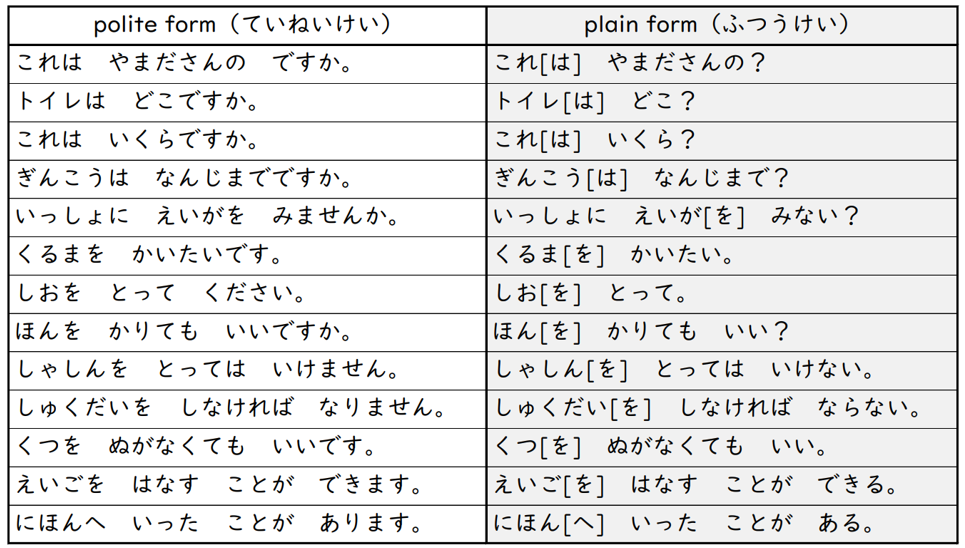
Plain form in grammar
Fun Japanese Lessons: Talk and Learn with Me!
Do you want to practice Japanese? Join my lessons!
If you’re interested, please contact me using the inquiry form below.

