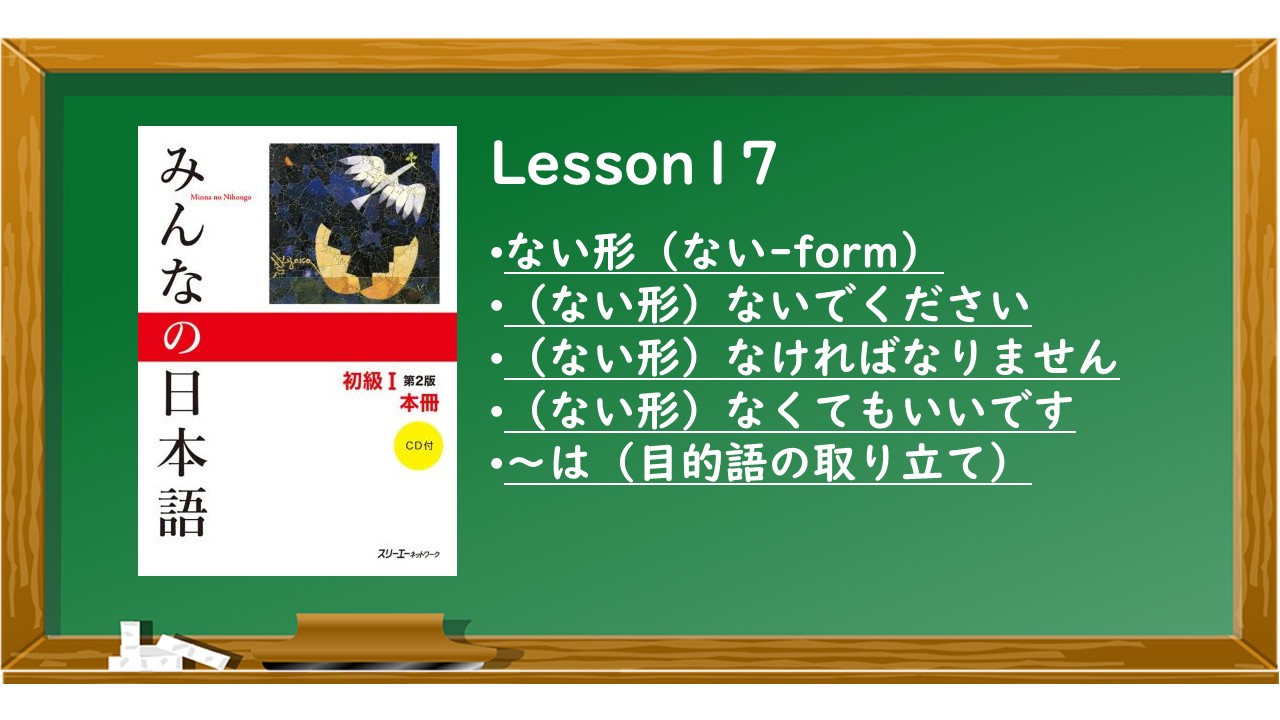
A1 ないけい(ない-form)
Meaning:
- The verb form used with ない is called the“ないけい(ない-form)”.
- For Group 1 verbs, the last sound of the ます-form is always from the“i”line. To make the ない-form, change that sound to the“a”line.
- The way to make the ない-form depends on the verb group, as explained below.

A2 ~ないでください
Meaning:
- “~ないでください”means“please don’t do (something).”
- This expression is used to ask or instruct someone not to do something.
- “~ないでください”means“please don’t do (something).”Also used to caution someone who is currently doing that action.
How to use:
[ない-form] ないでください
Example:
- この部屋に入らないでください。- Please do not enter this room.
- ここでたばこを吸わないでください。- Please do not smoke here.
- 大丈夫ですから、心配しないでください。- I’m okay, so please don’t worry.
A3 ~なければなりません
Meaning:
- “~なければなりません”means“must~.”
- This expression means something must be done, even if the person does not want to do it.
How to use:
[ない-form] なければなりません
Example:
- 明日、会社へ行かなければなりません。- I have to go to the office tomorrow.
- 毎日、宿題をしなければなりません。- I have to do my homework every day.
- 12時までに来なければなりません。- I have to be here by 12 o’clock.
「~までに」VS「~まで」
Meaning:
※「~までに(by)」
- It shows a deadline. The action must finish before that time.
例)明日までに宿題をしなければなりません。- I have to do my homework by tomorrow.
※「~まで(until)」
- It shows the time when something continues and then stops.
例)毎日7時まで働かなければなりません。- I have to work until 7 o’clock every day.
A4 ~なくてもいいです
Meaning:
- “~なくてもいいです”means“need not~.”
- This sentence pattern means you do not need to do the action.
How to use:
[ない-form] なくてもいいです
Example:
- 靴を脱がなくてもいいです。- You don’t have to take off your shoes.
- 土曜日は働かなくてもいいです。- I don’t have to work on Saturdays.
- お金を払わなければなりませんか。…いいえ、払わなくてもいいです。- Do I have to pay? … No, you don’t have to.
A5 ~は~
Meaning:
- Usually, the particle を is used with the direct object of a verb. But if you change を to は, the object becomes the topic, and you talk about it.
How to use:
[Noun] は~
Example:
- いつもご飯を食べますか。…昼ご飯は会社の近くで食べます。晩ご飯はうちで食べます。- Do you always eat? … I eat lunch near my office. I eat dinner at home.
- ここに名前を書いてください。住所は書かなくてもいいです。- Please write your name here. You don’t have to write your address.
Fun Japanese Lessons: Talk and Learn with Me!
Do you want to practice Japanese? Join my lessons!
If you’re interested, please contact me using the inquiry form below.