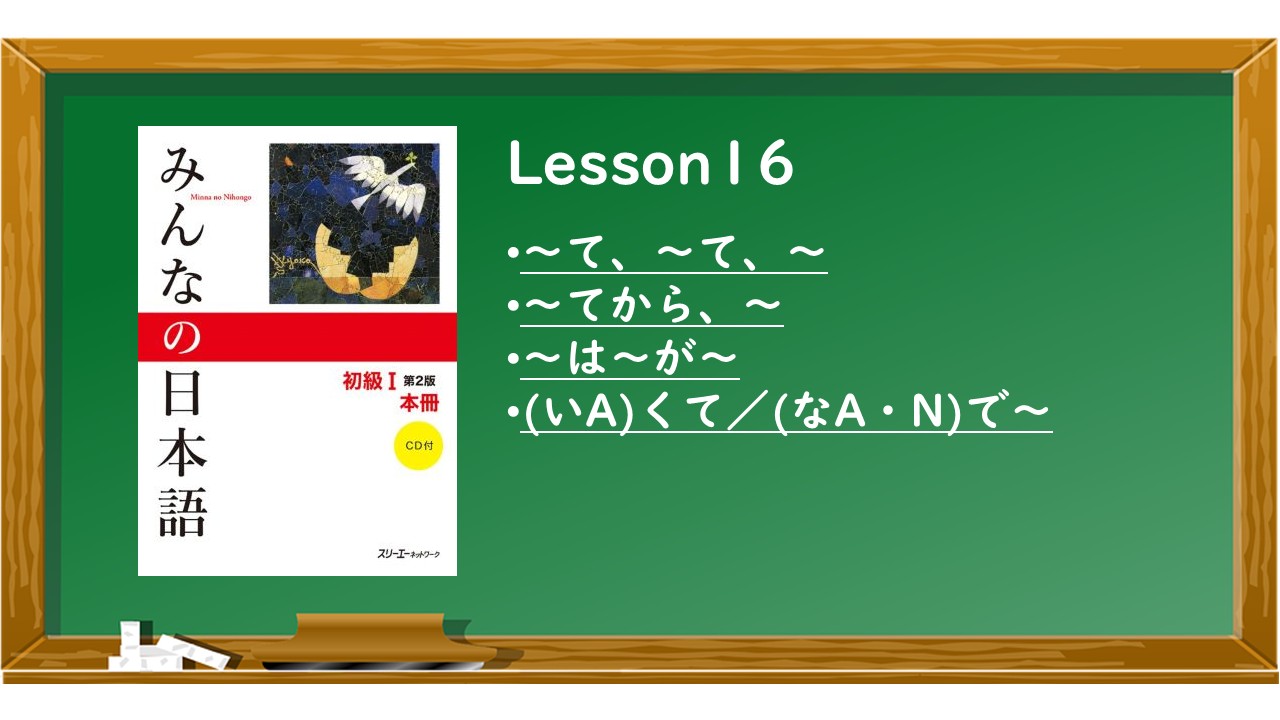
A1 ~て、~て、
Meaning:
- When two or more actions happen in order, use the “て-form” to connect the verbs. Say the actions in the order they happen.
- You can also use“それから”at the beginning of the last sentence.
- You can also use the“~て、~て、”form to give directions or explain how to use machines.
How to use:
[て-form] 、[て-form] 、
Example:
- 朝ご飯を食べて、シャワーを浴びて、出かけます。- I eat breakfast, take a shower, and go out.
- きのうは買い物して、映画を見て、友達とケーキを食べました。- Yesterday, I went shopping, watched a movie, and ate cake with a friend.
- どうやってチケットを買いますか。…お金を入れて、ボタンを押してください。- How do you buy a ticket? … Put in the money and press the button.
- デパートまでどうやって行きますか。…自転車で駅まで行って、電車に乗って、渋谷駅で降ります。- How do you go to the department store? … Go to the station by bicycle, take the train, and get off at Shibuya Station.
A2 ~てから
Meaning:
- This sentence pattern means you do Verb 2 after you finish Verb 1. You must finish Verb 1 first.
- You cannot connect three or more actions by repeating“~てから、~てから、~”.
How to use:
[て-form(Verb1)] から、~[Verb2]
Example:
- 勉強してから、ゲームをします。- I will play video games after I study.
- お金をおろしてから、スーパーへ行きます。- I will go to the supermarket after I withdraw money.
- もう宿題をしましたか。…いいえ、まだです。シャワーを浴びてから、宿題をします。- Have you already done your homework? … No, not yet. I will do my homework after I take a shower.
A3 ~は~が~
Meaning:
- This sentence pattern is used to describe the qualities or characteristics of things or people.
How to use:
[Noun] は [Noun] が [Adjective]
Example:
- 父は背が高いです。- My father is tall.
- 日本は料理がおいしいです。- Food in Japan is delicious.
- 旅行はどうでしたか。…海がきれいでした。- How was your trip? … The ocean was beautiful.
A4 ~くて/で
Meaning:
- When you connect an い-adjective to another sentence, remove the い at the end of the adjective and add くて.
- When you connect a noun or a な-adjective sentence to another sentence, change です to で.
How to use:
[い-Adjective い] くて
[な-Adjective] で
Example:
- このラーメンは安くて、おいしいです。- This ramen is cheap and delicious.
- 彼は頭がよくて、親切です。- He is smart and kind.
- 東京は便利で、楽しい町です。- Tokyo is a convenient and fun city.
- タイはどうでしたか。…海がきれいで、料理がおいしかったです。- How was Thailand? … The ocean was beautiful, and the food was delicious.
どの/どれ
Meaning:
- “どの”is used to ask about a specific person or thing from many options. It is followed by a noun.
- “どれ”is used to ask which one something is from many things. It is used alone, not before a noun. You do not use it to ask about people.
How to use:
どの [Noun] ですか
[Noun] は どれですか
Example:
- 新しい先生はどの人ですか。…あの背が高くて、かっこいい人です。- Which person is the new teacher? … That tall and cool person.- Which one is Mr. Sato’s bag? … That big, black bag.
- 佐藤さんのかばんはどれですか。…あの大きくて、黒いかばんです。
Fun Japanese Lessons: Talk and Learn with Me!
Do you want to practice Japanese? Join my lessons!
If you’re interested, please contact me using the inquiry form below.