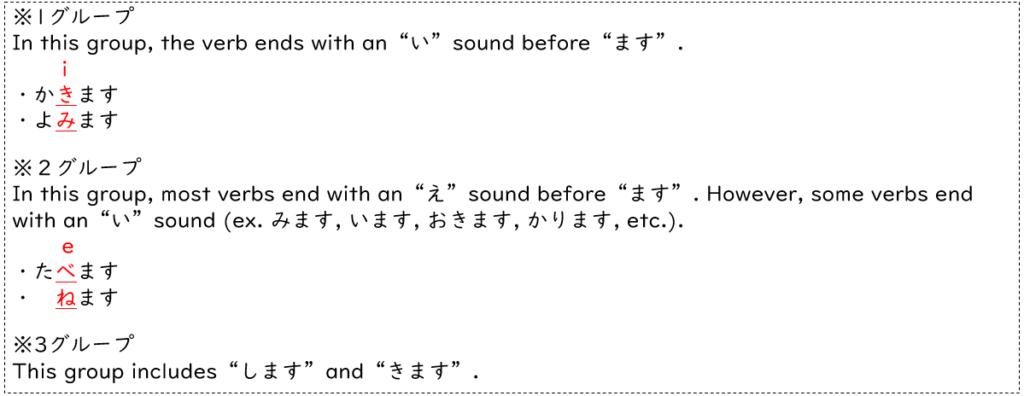
どうしのグループ
Meaning:
- Japanese verbs change their forms to express various meanings. These verbs are divided into three groups. Each group has its own rules for changing forms.
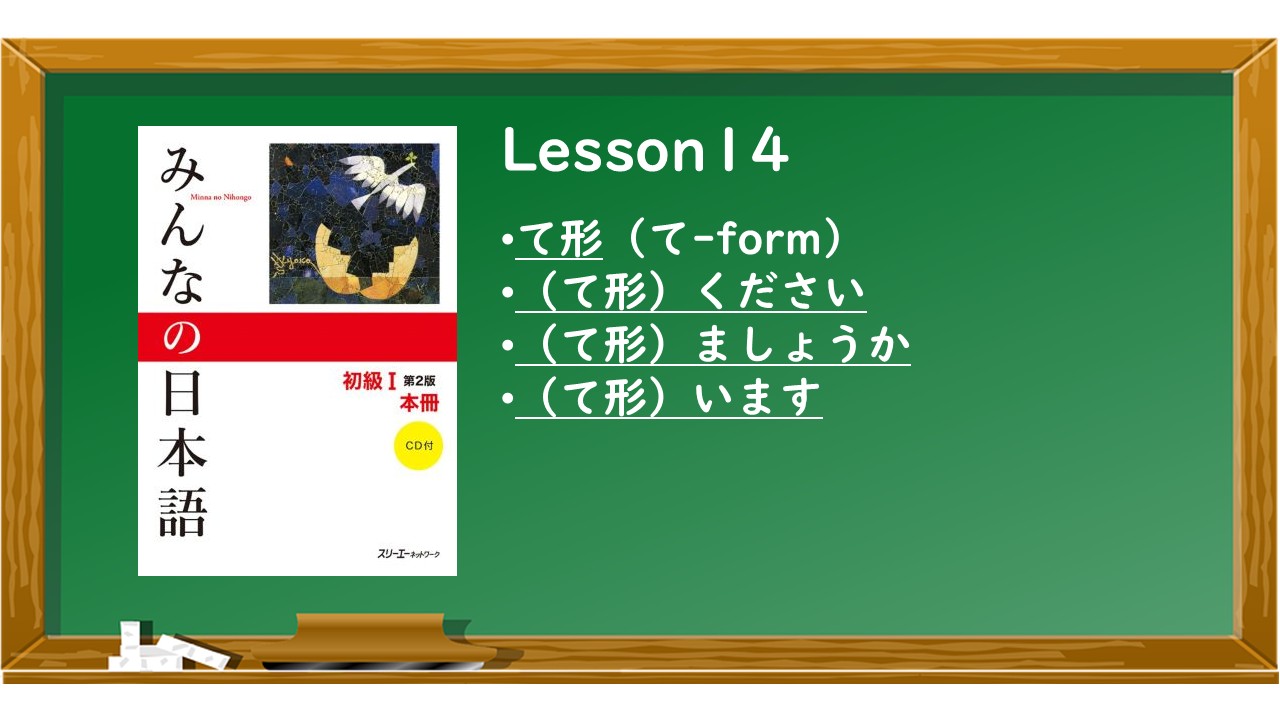
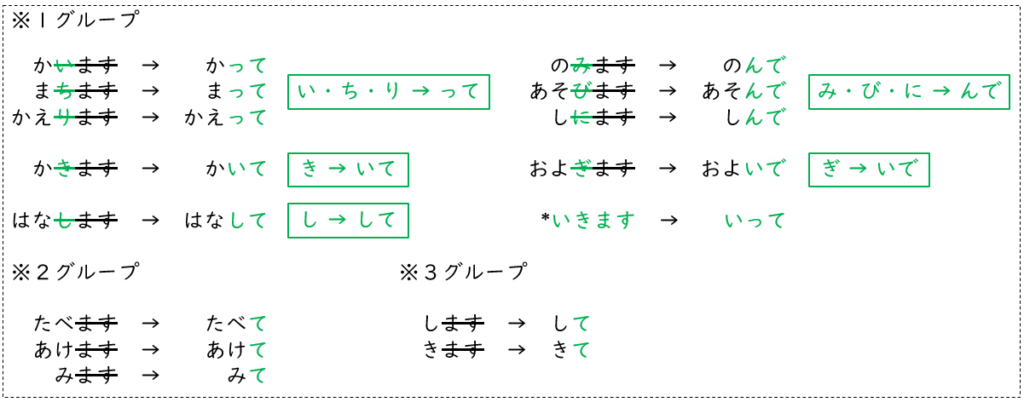
A1 てけい(て-form)
Meaning:
- The verb form ending in“て”or“で”is called the“てけい(て-form)”. The way to make the て-form depends on the verb group, as explained below.
A2 ~てください
Meaning:
- This sentence pattern is used to ask, suggest, or encourage someone to do something.
- Adding“すみませんが”(Excuse me, but) at the beginning of a sentence makes it more polite and softer than just saying“~てください”.
- When encouraging someone to do something, you often add“どうぞ”.
How to use:
[て-form] ください
Example:
- これを読んでください。- Please read this.
- すみませんが、手伝ってください。- Sorry, could you help me?
- どうぞ食べてください。- Please eat.
A3 ~ましょうか
Meaning:
- Use this expression when you offer to do something for the listener.
How to use:
[ます-form] ましょうか
Example:
- 手伝いましょうか。- Shall I help you?
- 窓を開けましょうか。…ええ、お願いします。- Shall I open the window? …Yes, please.
- 荷物、持ちましょうか。…いいえ、けっこうです。- Shall I carry your bags? …No, thank you.
A4 (いま)~ています
Meaning:
- This pattern shows that a specific action or movement is happening right now.
- When explaining natural phenomena, the subject is marked with“が”.
How to use:
[て-form] います
Example:
- 今、日本語を勉強しています。- I am studying Japanese now.
- お父さんは今、何をしていますか。…テレビを見ています。- What is your father doing now? …He is watching TV.
- 山田さんはだれと話していますか。…鈴木さんと話しています。- Who is Mr. Yamada talking to? …He is talking to Mr. Suzuki.
- 今、雨が降っています。- It is raining now.
Fun Japanese Lessons: Talk and Learn with Me!
Do you want to practice Japanese? Join my lessons!
If you’re interested, please contact me using the inquiry form below.