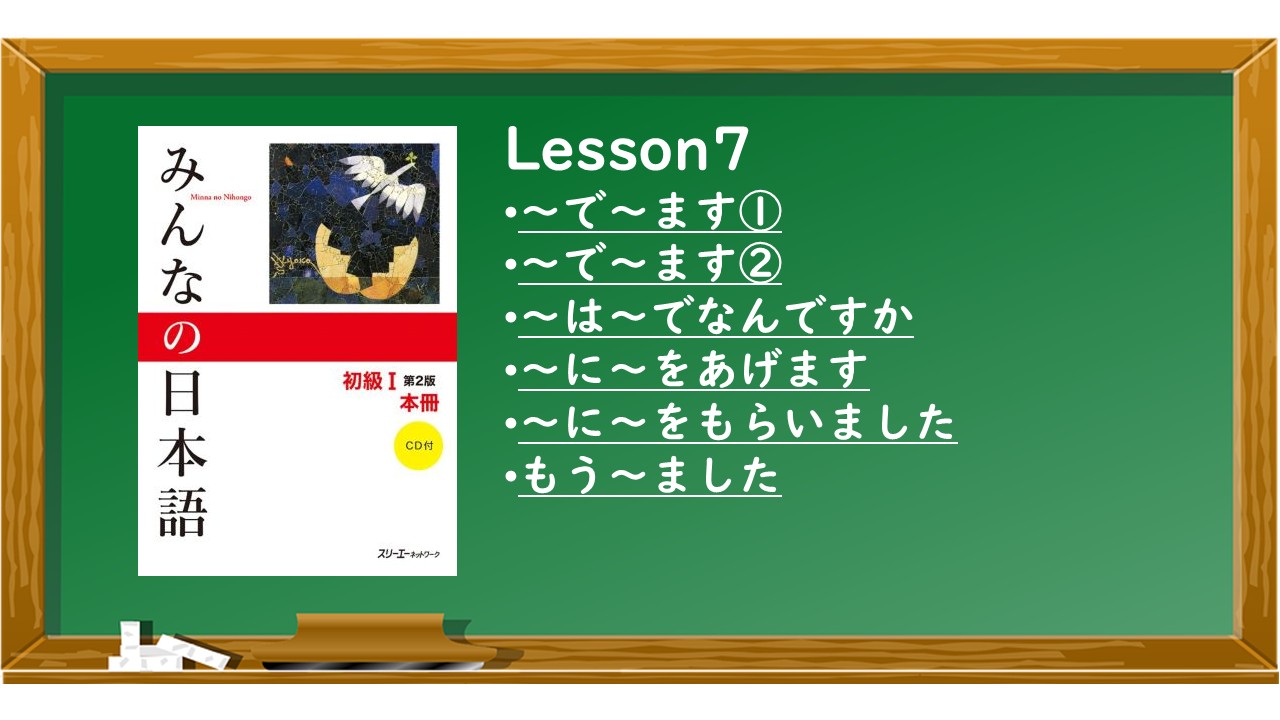
A1 ~で~ます①
Meaning:
- The particle“で”shows the method or means used to do something.
How to use:
[Noun] で [Verb]
Example:
- えんぴつで手紙(てがみ)を書(か)きます。- I write a letter with a pencil.
- スマホで写真(しゃしん)を撮(と)ります。- I take a picture with a smartphone.
- 何(なん)ですしを食(た)べますか。…はしで食べます。- How do you eat sushi? … I eat it with chopsticks.
A2 ~で~ます②
Meaning:
- Use“で”to say which language you use to do something.
- When you ask which language someone uses, say“なにごで.”
How to use:
[Noun(language)] で [Verb]
Example:
- 英語で映画を見ます。- I watch a movie in English.
- 何語で手紙を書きますか。…日本語で書きます。- What language do you write the letter in? … I write it in Japanese.
A3 ~は~で~です
Meaning:
- This pattern is used to explain how to say a word or sentence in another language.
How to use:
[Noun(word1)] は [Noun(language)] で [Noun(word2)] です
Example:
- 「こんにちは」は英語で“Hello”です。-“Konnichiwa”is“hello”in English.
- これは日本語で何ですか。…いすです。- What is this in Japanese? … It’s “isu(chair)”.
- “desk”は日本語で何ですか。…「つくえ」です。- What is“desk”in Japanese? … It’s“tsukue.”
A4 ~に~をあげます
Meaning:
- “あげます” means “to give”.
- This “に” shows where the action goes. In this case, it shows an object moving to a person.
- You cannot use “わたし” in the person part of 「(person) に~あげます」.
How to use:
[Noun(person)] に [Noun(thing)] をあげます
Example:
- 母に花をあげます。- I give flowers to my mother.
- 彼女に何をあげましたか。…かばんをあげました。- What did you give her? … I gave her a bag.
- だれにプレゼントをあげますか。…彼にあげます。- Who will you give the present to? … I will give it to him.
- 彼にお金を貸しました。- I lent him money.
- 彼女に手紙を送りました。- I sent her a letter.
- 母に手紙を書きました。- I wrote a letter to my mother.
- 友達に電話をかけました。- I called my friend.
- 学生に日本語を教えました。- I taught Japanese to the student.
A5 ~に~をもらいます
Meaning:
- “もらいます” means “to receive”.
- This “に” shows who you receive something from (the source of the action).
- You cannot use “わたし” in the person part of 「(person) に~もらいます」.
How to use:
[Noun(person)] に [Noun(thing)] をもらいます
Example:
- 父に時計をもらいました。- I received a watch from my father.
- お父さんに何をもらいましたか。…くつをもらいました。- What did you receive from your father? … I received shoes.
- だれにその花をもらいましたか。…彼にもらいました。- Who did you get those flowers from? … I got them from him.
- 母にお金を借りました。- I borrowed money from my mother.
- 父に電話をもらいました。- I received a phone call from my father.
- 佐藤先生に日本語を習いました。- I learned Japanese from Mr. Sato.
A6 もう~ましたか。…はい、~ました。/いいえ、まだです。
Meaning:
- “もう” means “already” and is used with “Vました”. In this case, “Vました” indicates that the action has been completed.”
- “まだです” means “not yet”.
Example:
- もう宿題をしましたか。…はい、しました。- Have you done your homework yet? … Yes, I have.
- もう昼ご飯を食べましたか。…いいえ、まだです。- Have you eaten lunch yet? … No, not yet.
Fun Japanese Lessons: Talk and Learn with Me!
Do you want to practice Japanese? Join my lessons!
If you’re interested, please contact me using the inquiry form below.